A Trip to Tokushima to Consider Japanese Umbrella Making: Mima Wagasa and Kyo Wagasa
"I want to visit the Mima Wagasa workshop sometime."
This sentiment was the starting point for this exchange meeting between "Mima Wagasa and Kyo Wagasa."
All the craftsmen from Hiyoshiya got into a car and drove from Kyoto to Mima City, Tokushima Prefecture.
After a four-hour drive one way, we visited "Mima Wagasa."
A town where nearly a million Japanese umbrellas were once made
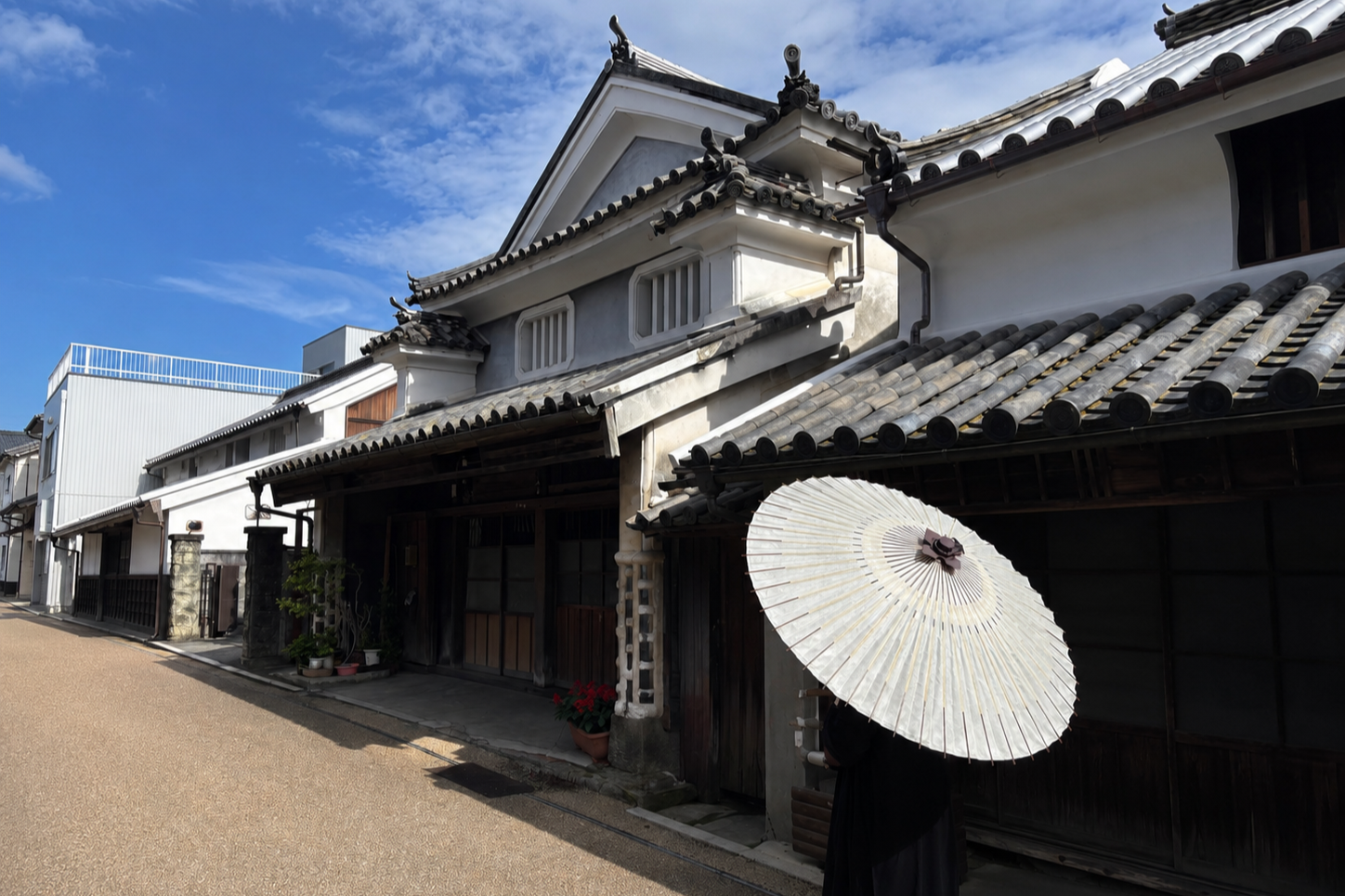
Wakimachi, Mima City, Tokushima Prefecture.
This area, now known for its "udatsu townscape,"
was once a major production center for Mima wagasa.

Around 1955, over 200 wagasa shops lined the streets,
and it is said that nearly a million wagasa were produced annually during its peak.
Mima wagasa developed primarily around practical rain umbrellas, known as "Awa Bangasa."
In addition to large and sturdy bangasa, vividly colored janome-gasa (bull's-eye umbrellas), indigo-dyed umbrellas, and nodategasa (outdoor tea ceremony umbrellas) are also made.
However, with changes in the times, the demand for wagasa decreased,
and wagasa production in Mima, once prosperous, almost ceased.
It was then that the "Mima Wagasa Production Group" was formed
to connect Mima's wagasa to the future once again.

Currently, operating as the general incorporated association AWACRAFT Mima Wagasa,
they are engaged not only in wagasa production but also in activities to convey its techniques and charm through experiences such as making mini wagasa and lamp shades.
Making our own parts
When I experienced the craftsmanship of Mima Wagasa,
what surprised me first was the breadth of their craftsmanship.
The craftsmen of Mima do everything themselves, from cultivating the styrax tree, which is the raw material for the crucial umbrella part, the rokuro (runner),
to harvesting bamboo and processing it into umbrella ribs,
and even the process of "do-bari" (pasting the paper) and "abura-hiki" (oiling).
"To make good products, it's important to discern good materials and tools with our own eyes."
Based on this philosophy, they approached their craftsmanship by researching each step,
one by one.
What I felt from their approach was not so much about "preserving" tradition,
but rather an attitude that resonates with Hiyoshiya's philosophy of "continuously thinking for ourselves."
Are these materials good enough?
Isn't this tool easier to use?
How can we achieve a more beautiful finish?
It was strongly conveyed that they enjoy asking such questions
and work on their daily production.
Even with the same wagasa, the making process differs
During the exchange of ideas, we were shown the tools they usually use and discussed the manufacturing process.
As the conversation progressed, new discoveries kept emerging, such as "Even with the same wagasa, they are so different."

For example, even with the same "Kikyo-wari" (bellflower splitting), the bamboo splitting method differs.
The application method for cashew lacquer differs, and there are also differences in the materials used for waterproofing.

Even seemingly small differences
are important innovations that reflect the accumulated experience of craftsmen.
Kyoto and Mima.
Different places mean different users, environments, and histories.
That's why I believe there is a charm in "local wagasa"
that has been nurtured in each region.

Tradition is a series of innovations
Wagasa craftsmanship is a skill that has been passed down for a long time.
However, tradition cannot continue by merely repeating the same things.
As materials, tools, lifestyles, and demands change,
craftsmen think, devise, and sometimes learn from techniques in other regions, gradually updating their methods.
Visiting Mima this time made me strongly feel this once again.
Learning daily, thinking, and working with our hands.
We want to continue creating wagasa that people will find appealing in the coming era.
To everyone in Mima, thank you for the valuable time and learning.
We look forward to seeing you again someday.